
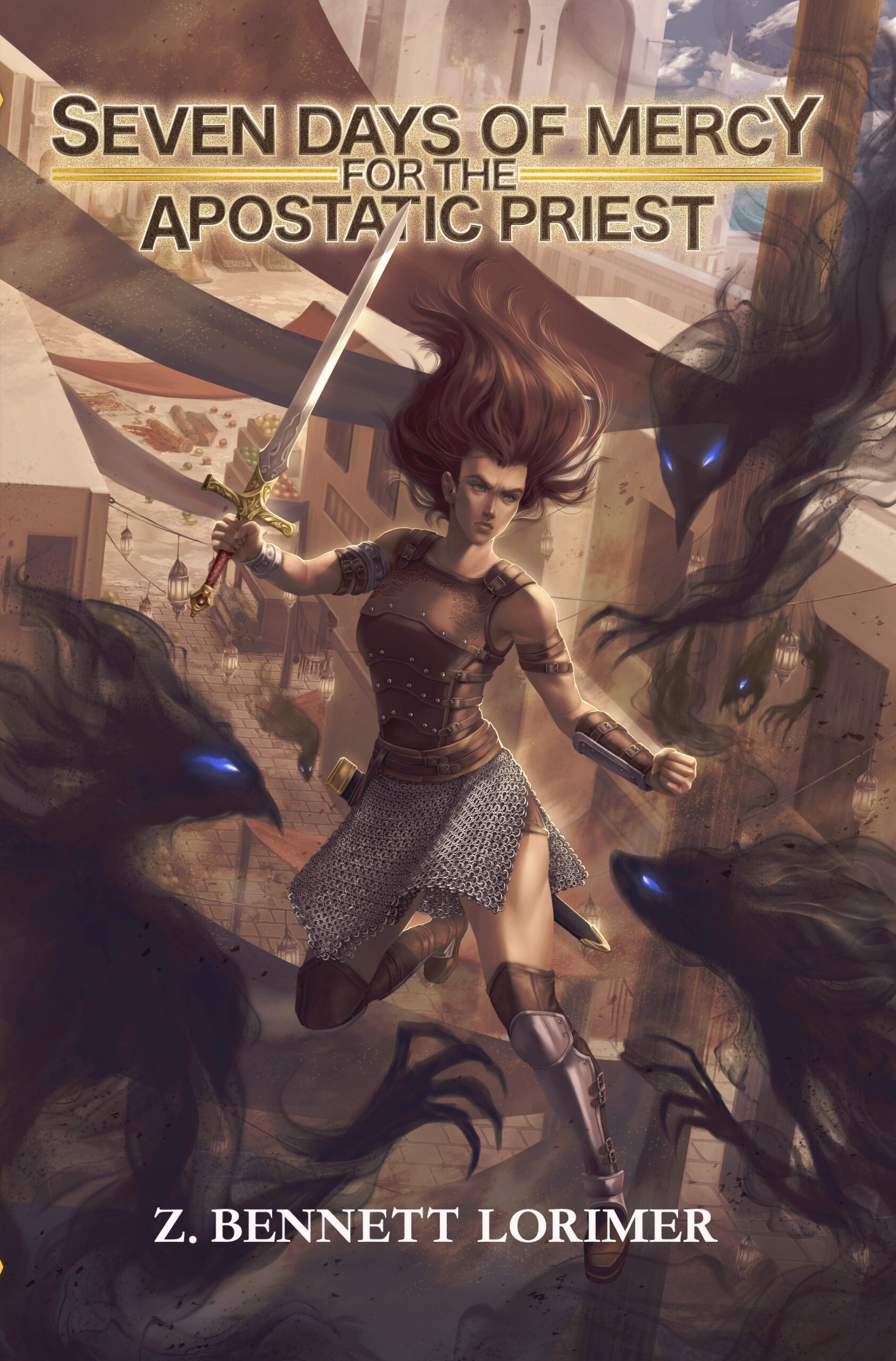
For this week’s Q&A, I imposed upon all the folks with early access to Seven Days of Mercy for the Apostatic Priest via the ARC or the Extended Preview to send their questions for a Hebdomar-spanning featurette. I was entirely impressed by the quality and incisiveness of the questions. The Divine Heretic series can be a lot to unpack, so I’m excited (and relieved) to hear how many of you have enjoyed the unpacking. I did try to answer every question via email, and though I won’t be able to print them all here, everyone who sent in a question will get their free ARC of What Lies Between when those galleys become available. Thanks again for making this featurette a success.
If you haven’t scored your copy yet, what are you waiting for?
Onto the questions…
From Sandra B. in Tempe, AZ:
I’m still thinking about Seven Days of Mercy for the Apostatic Priest after finishing the ARC last week. Considering his resurrection, is Luka intended to be a Christian allegory?
Great question. I’ve written a little bit about my antipathy for didactic fiction, and that antipathy extends to direct allegories. But storytelling is dialog between writer and reader, and authorial intent is only one half of the text. Luka is not intended to be a direct Christian allegory, but the metaphysics of Hebdomar draw significantly from Jewish, Christian, and Islamic mysticism–specifically from Sufi and Kabbalah practices. Readers with specific religious backgrounds will likely discover many resonant themes and motifs in The Divine Heretic series, but I did not intend any direct commentary on specific religions or religious practices. Thematically, The Divine Heretic explores the nature of faith and the virtue of doubt in general, so it can be read as a story contextualizing any faith or no faith at all. How each reader interprets this thematic work will depend on each reader’s specific background and relationship to spirituality, and no reading is wrong.
It will be hard to glean this piece from Book 1, but there’s also a Neo-Platonist thread running through the series, which will be more prominently displayed in Book 2. Any reader who enjoys exploring these philosophical and theological themes will find much to love as the series develops.
From u/laliloliblahblahblah:
What was the real-world inspiration for the city of Mahakalpe?
Mahakalpe is not intended to be a stand-in for any historical or extant city. The fictional city’s organization draws inspiration from Bronze Age urban centers in Mesopotamia and the Levant, though it’s much larger by population than any of those ancient cities.
In its design, I did spend some time studying holy cities like Mecca, Jerusalem, Kashi, and–fascinatingly (for me)–Jackson County, Missouri. You’re savvy to pick up on some features adapted from these locations. Mahakalpe is the destination of a pilgrimage like Mecca, and the prophesied site of a divine return like Jerusalem and Jackson County.
From George C. in Hudson, NY:
I think you might be misclassifying The Divine Heretic as sword and sorcery. It reminds me of [Steven Erkson’s] Malazan and [R. Scott Bakker’s] The Prince of Nothing more than anything else. Why not just call it grimdark epic fantasy?
Potato/Po-tah-to, my friend. Genre analysis is not a perfect science, but I think you make a good point vis-a-vis the specific texts you cite. The Divine Heretic is inspired by classic sword and sorcery tales, but I see it more as a modern evolution of the classical mode, than a pure emulation or a return-to-form. As much as I adore the old Conan stories and pretty much every word ever written by C.L. Moore, it would be dishonest to ignore the genre’s limitations. The lack of interiority in the golden age stories does lead to some thin characterization, and though I’d argue Robert Howard was doing some deeper character work than he gets credit for, the reams of pastiche that followed his initial output don’t always represent the IP in the most flattering light.
I still think that Ruxindra evokes these seminal, deific heroes of sword and sorcery, but I also tried to bring more contemporary elements of craft to bear on this series. I want The Divine Heretic to appeal to classical purists and modern readers alike, so a bigger emphasis on interiority and some more contemplative moments within the plot became essential.
I think the Malazan comparison is probably the most apt. That’s another series with a well-earned reputation for dropping readers into a complex world without any spoonfed exposition. But Malazan is an ensemble text, whereas The Divine Heretic lives exclusively inside Ruxindra’s POV. That’s probably the biggest point of divergence from modern epic fantasy trends. I also think this tight focus helps readers navigate the opacity of the prose. A lot of readers bounce off Gardens of the Moon, which is a shame. Malazan is great, but it doesn’t lead with its best face.
From Kelly W. in Brooklyn, NY:
Will the next book be set in the same region?
Nerp. Ruxindra and co. will move on from Mahakalpe and the deserts of Ohtahp. What Lies Between picks up the story upon Ruxindra’s arrival in the stateless land of Neleoth, far east of the locations in Book 1.
From Stephanie Z. on planet Earth:
Hi! I was one of your ARC readers for both Ardent Wings on Jealous Skies and Seven Days of Mercy for the Apostatic Priest. Very different reads, but I picked up on feminist themes in both books. Was this intentional?
Thanks for the question and the early reads, Stephanie. Happy to have you on board. As with the answer to the question above, I never embark on any writing project with a didactic purpose in mind, though I am happy to hear about this reading. Both Tales of Ciel and The Divine Heretic focus on female points of view and feature what I would consider well-rounded, three-dimensional, and agentic female characters. I think that more than anything contributes to a feminist flavor.
It’s a bit coy of me to deny any explicitly feminist themes in Seven Days of Mercy. The conflict centers around a virgin sacrifice, and does explore the way religious fundamentalists fear and attempt to bridle female sexuality. Through Ruxindra’s voice, we do get some pretty forward commentary on that condition, though I think it ties directly into the plot of the book in a way that isn’t jarring or extratextual.
I didn’t open a blank document and set out to publish a feminist manifesto in fantasy novel form, but a broader exploration of faith, fundamentalism, and doubt required me to confront the way those currents interact with gender and gender equality.
From Ryan C. in California:
I really liked Ardent Wings on Jealous Skies and I loved Seven Days of Mercy even more. Ruxindra is a badass. I liked Gerritt also, but couldn’t really get a read on him. How did he end up with Ruxindra? Where did he get his power? Is he tied to some other god?
Ah, Master Gerritt. Such an enigma. I’m allergic to dumping exposition that doesn’t relate directly to the plot at hand, so many aspects of our central characters and the world of Hebdomar remain opaque throughout Seven Days of Mercy. Readers will probably note some sort of ontological distinction between Gerritt’s true sorcery and the lower crafts, like Thaumaturgy, that surface in the course of the narrative, though the boundaries between the categories remain largely undefined. For worldbuilding buffs, I promise you’ll learn more as the story progresses, and as these metaphysical details become relevant to subsequent entries.
Gerritt’s power is unique, and it is tied to another deity from another pantheon. Hebdomar is a land of intersecting pantheons and faiths, and the Demiurge is not the only–nor the oldest–G-d to walk the mortal plane.
I wish I could say more, but there be spoilers.
Next week we return to the open call for any and all questions related to HTP works or whatever else is on your mind. If you would like to submit a question to be printed and answered (anonymously or otherwise), simply send your question to [email protected]. No question is off limits!