
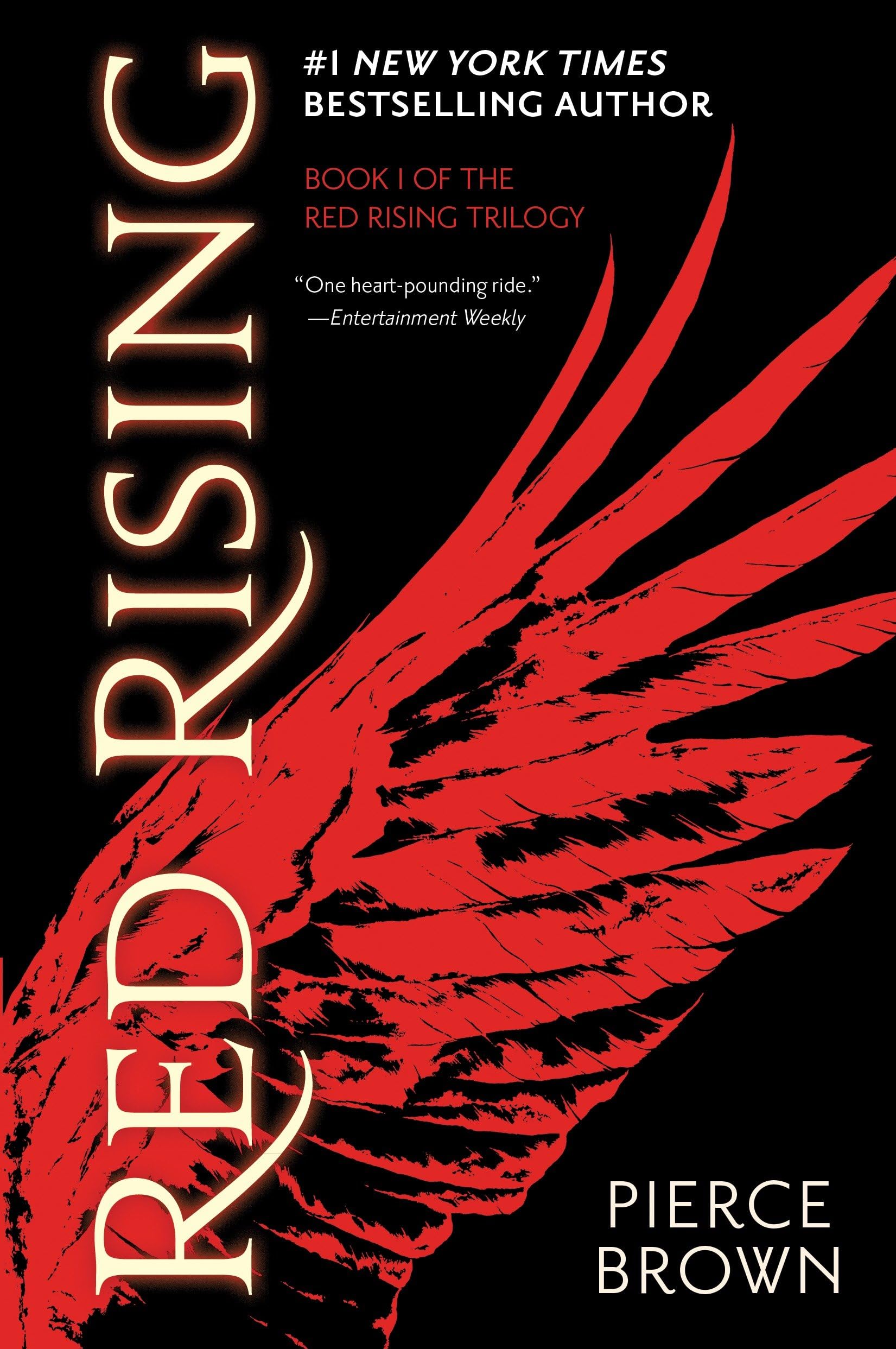
I’m a little late to the game, but I just finished reading Pierce Brown’s popular Red Rising, and I have thoughts. This isn’t a review, but more of an analysis. This may be an unpopular opinion, but I don’t think it’s healthy for artists to moonlight as critics. I don’t read to rank, but to discover.
A preface:
I’ve been writing professionally for 18 years, and publishing fiction for about 10. In that time, I’ve taught creative writing at the college level and in community workshops. I make a simple recommendation to new writers in every workshop:
Read.
Read widely and voraciously. Read contemporary fiction and classics. Read your favorite genres and outside your comfort zone. If you want to be a novelist, read novels. If you’re writing short stories, read short stories. Learn the forms you aspire to create by consuming them, and then think about them. This advice seems self-evident to me, but I’ve found that many new writers approach fiction out of love for anime, or movies, or video games. I’m not going to ghettoize any particular medium. I’ve encountered beautiful and moving narratives in all of the above, but narrative is just the skeleton of your project. Every writer I’ve worked with has a great story they want to tell, and I suspect they choose fiction as their mode because it’s so accessible. It requires collaboration and hard skills to code a video game or shoot a film, but anyone with a pen and fluency can write prose.
But the novel is its own form, and you won’t be able to use that form to communicate the brilliant stories in your head unless you’ve immersed yourself in it. You can’t approach prose as a creator if you’re not already a consumer. I doubt there are any musicians out there who don’t listen to music. I don’t think there are any directors who don’t watch movies. If you don’t read novels, you can’t write them–full stop. There’s no magic number. You don’t have to read 100 novels a year or 2-3 a week or clear any other nonsensical bar, but you do have to read consistently and thoughtfully. To quote an aphorism I first encoutnered in grad school: “It’s not about how many books you move through, but how many move through you.”
After I finish reading a novel I like to jot my thoughts down, not because I’ll necessarily revisit them, but because it helps me organize and retain the lessons I took from the experience. I think best through the written word. I consider myself a generous reader. I don’t read looking for nits to pick (though nits sometimes insist upon themselves). I, rather, approach every novel looking for things to admire, and I try to read works of fiction on their own terms. Instead of focusing on my own narrow sweet spot, I try to think about what the novel is trying to accomplish and how well it completes the task it set for itself. That doesn’t mean I love or even like everything I read–far from it. But I’ve come away from very few reading experiences without some positive takeaway.
Conceitedly, I think this is an effective reading approach for writers, though I know a few excellent writers who take the exact opposite position. There’s no best way, but this is mine.
About Red Rising…
Red Rising is one of the most popular sci-fi series of the last 20 years

The first book has been sitting near the top of my To Read pile for years. As I dive deeper into my own space opera, I decided it was time to take the plunge. Popular fiction often polarizes the SFF readership, and Red Rising is no exception. Some of the common critiques are fair. Brown certainly jumped on a trend with this story. The first book is very much Hunger Games on Mars, but there’s no crime in imitating a popular formula as long as you bring an original voice and some novelty to the act.
I know there are seasoned SF readers who thumb their noses at any novel with mass appeal. I also know plenty of writers who feel the same way, but novels are entertainment and readers aren’t dumb. You can mock Stephenie Meyer and E.L. James all you want, but any story that resonates with hundreds of thousands of people has merit and is worth studying.
All that said, I was not expecting a master class in prose style from Brown, but I was pleasantly surprised by the quality of the line-by-line writing. Darrow’s voice is urgent and compelling, and Brown’s prose is sparse but evocative–a good match for his lone POV character. One of the benefits of writing in a first-person POV is that the character’s interiority flows naturally, and for a plotty pulp, Red Rising gives us just enough interiority to stay invested in Darrow’s character. There are moments where I wanted more vivid description, but that’s not Brown’s game. He plunges us through the plot at a breakneck pace with little time to linger on the setting. I think this was a conscious tradeoff. Red Rising is a well-paced action novel that covers quite a bit of ground in just about 400 pages in trade paperback (short by the standards of the genre). Sustaining that pace typically comes at the expense of description, character, or both. Cutting character is a dangerous game, so Brown makes the right choice by limiting the former.
For what he’s trying to accomplish, Brown’s formula works. An immersive POV with a strong motivational thread and a satisfying character arc. Consistent and vivid action scenes that don’t overstay their welcome. A fast-moving plot built from short scenes that don’t wander. If I could make one structural critique it would be that the individual scenes are so concerned with forward momentum that they don’t always do much to subvert expectations, and though the conflicts are dire, the resolutions don’t always feel earned or entirely satisfying.
Roman history is having a moment

SFF worlds inspired by classical Rome seem to be proliferating. These trends come in and out of fashion, but it’s interesting to think about why they enter the collective consciousness when they do. Thirty years ago, you couldn’t throw a stone in the genre section of your local bookstore without hitting a medieval fantasy set in a magical, costumed version of western Europe. We’ve moved on (or, rather, backward) to antiquity. Writers like Pierce Brown, Christopher Ruocchio, and James Islington have found success with their Roman milieus, so I expect to see more of this before it tapers off. You don’t have to squint very hard at these works to see the scaffolding of the Late Republic with its crumbling plutocracy populated by towering archetypes like Caesar, Pompey, Marius, and Sulla.
There are advantages to tapping these deep veins of cultural context, but hazards also abound. Some of our oldest stories and archetypes originate in Greco-Roman mythology. These images, names, and allusions bring layers of resonance that can enrich your story when deployed effectively. You can draw a straight line from Pygmalion to My Fair Lady to Weird Science. The conflict at the center of Hesiod’s Theogony between the Olympians and Titans provides the thematic bedrock for every story of generational conflict from the last 3,000 years of the Western canon. But because this is such well-worn territory, it’s very challenging to do anything inventive or fresh with the tropes of the Late Republic or Greco-Roman mythology. The imperative to do these stories justice also hovers like an albatross over every new take that attempts to leverage their cache. You wouldn’t leave the Mona Lisa furled up on your bedroom floor propped up against an underutilized Peloton bike. If you want to play with the valuables, you better do them justice.
I have a few theories why these stories seem more prevalent in this literary moment. I wouldn’t overlook the impact the of “All men are obsessed with Roman Empire” meme, but I also think there’s some greater societal interest in the conditions that transform a republic of purported enlightenment to an autocratic empire and on to inevitable collapse. To steal another aphorism, “History doesn’t repeat itself, but it does rhyme.”
The setting in Red Rising does feel familiar. A pseudo-Roman republic on Mars comprised of a colored caste system dividing the ruling “Golds” from the Publicani “Pinks, Browns, Obisdians, and Greens” and the enslaved “Reds.” Brown deploys his Roman lexicon generously. We’ve got praetors and imperators and legates, and they all function about how you’d expect in the Society. These devices aren’t the most sterling example of Brown’s worldbuilding. Red Rising is much more intriguing in the way it utilizes and alludes to Greco-Roman mythology.
Early in the narrative, Darrow is enrolled in a barbaric academy where young Golds are sorted into houses named for Roman deities–Apollo, Hades, Mars, Juno, Diana, Pluto. All the most popular Latinate influencers are accounted for. These houses are then set against each other in a violent tribal war of all-against-all, wherein the students are expected to battle for supremacy and remake something resembling the lines of civlization. Each house is managed by a namesake proctor. The proctors watch the brutal game of nation-building from their perch on–you guessed it–Olympus, coming down to chastise, belittle, admire, cheat, and–occasionally–to help. Brown isn’t exactly remaking the wheel here, and the allusions are all pretty on-the-nose, but I was impressed by the way this dynamic between the embattled students and their capricious proctors faithfully recreates the mythological relationship between the Romans and their Gods.
Scholars of classical mythology use the term “sublime frivolity” to describe the attiude of the Gods toward mortals. On the one hand, the Olympians are these omnipotent, immortal deities, and yet they’re often motivated by petty mortal vices like jealousy and wrath. It’s an interesting notion–that a pantheon of awesome beings might emulate the most undignified and impulsive proclivities of their creations, and it’s this seeming paradox that drives much of Greco-Roman mythology.
I see the ghost of this relationship in the way the proctors interact with the students in Red Rising. Although the proctors are not immortal, the game vests them with near-omnipotent power and an all-seing eye by virtue of a little techno handwaving. Even with all that power over the students, their actions are driven by the same base emotions that motivate the mythological Olympians–pettiness, jealousy, greed. They put their thumbs on the scale thoughtlessly, usually in service of their own ends. It’s an interesting symmetry with the source material. Props to Brown for capturing this abstract concept.
Overall, Brown’s execution compares favorably to the Roman milieu in Islington’s The Will of the Many, which didn’t really land for me. For an even more intriguing Roman-style society in space, I highly recommend Christopher Ruocchio’s Sun Eater series.
How to space opera: aligning reader expectations

Space opera is a subgenre so broad that it’s become almost meaningless. When I’m in a cynical mood, I argue that all genre is a marketing construct. That’s true in a sense, but if I’m being more thoughtful about it, I think there is value in genre analysis, if only because it provides a shared vocabulary we can use to compare works with common elements of plot and setting.
Red Rising is a space opera in the conventional sense, but if you go into this series expecting a sprawling epic, you’re going to be disappointed. The far-future Mars setting is little more than facade. The actual story shares more genetic material with YA rags-to-riches stories like The Hunger Games and the popular academic subgenre launched to primacy by the Harry Potter series.
When I think about great contemporary space operas pushing the genre to exciting new places, others leap to mind: The Sun Eater, The Expanse, Adrian Tchaikovsky’s Children of Time, Arkady Martine’s A Memory Called Empire. That’s not really a knock on Red Rising. I don’t think Brown is working in the tradition of Isaac Asmiov, Peter F. Hamilton, Ian M. Banks, and Ursula LeGuin, and that’s okay. For what it wants to be, Red Rising largely works.